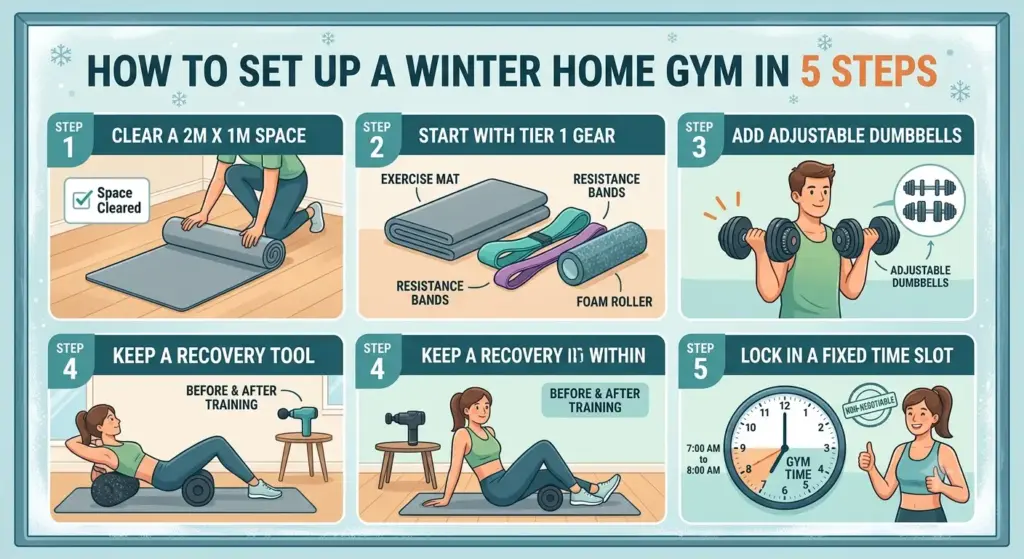
The best home workout equipment for an Australian winter pairs compact strength equipment, resistance bands, and adjustable dumbbells for beginners and pros with dedicated recovery gear like a foam roller or a massage gun. Together, they let you train safely on cold mornings without leaving the house, and a genuinely complete setup can be built for well under $300.
Home workout equipment is any gear designed to deliver a gym-equivalent training effect inside a house or apartment, without the space, cost, or scheduling demands of a commercial gym. For winter training specifically, the most useful items fall into three categories: strength tools (dumbbells, bands), recovery tools (foam rollers, massage guns), and low-impact cardio options (indoor bikes, rowers) that don’t depend on the weather outside.
Cold weather doesn’t just dent motivation — it measurably changes behaviour. A 13-month tracking study of Adelaide adults found that daily moderate-to-vigorous activity declined as overnight minimum temperatures fell, with similar declines associated with rain and wind. That’s consistent with the bigger picture nationally: only 22.4% of Australian adults met the national physical activity guidelines in 2022, per the Australian Bureau of Statistics.
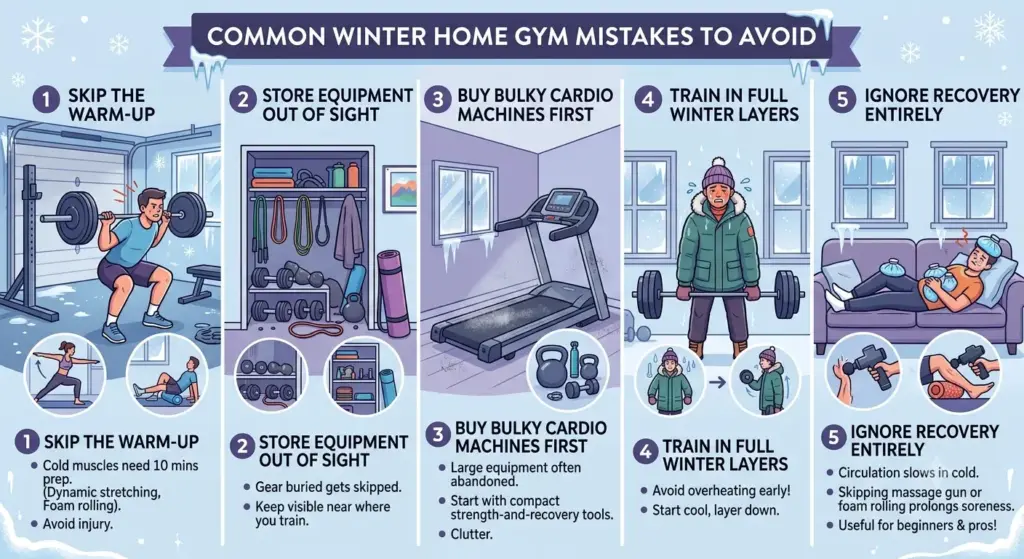
Cold muscles also behave differently — they take longer to warm up, which increases the risk of injury if you jump straight into a session. Add shorter daylight hours, and it’s easy to miss both the pre-work and after-work training windows entirely.
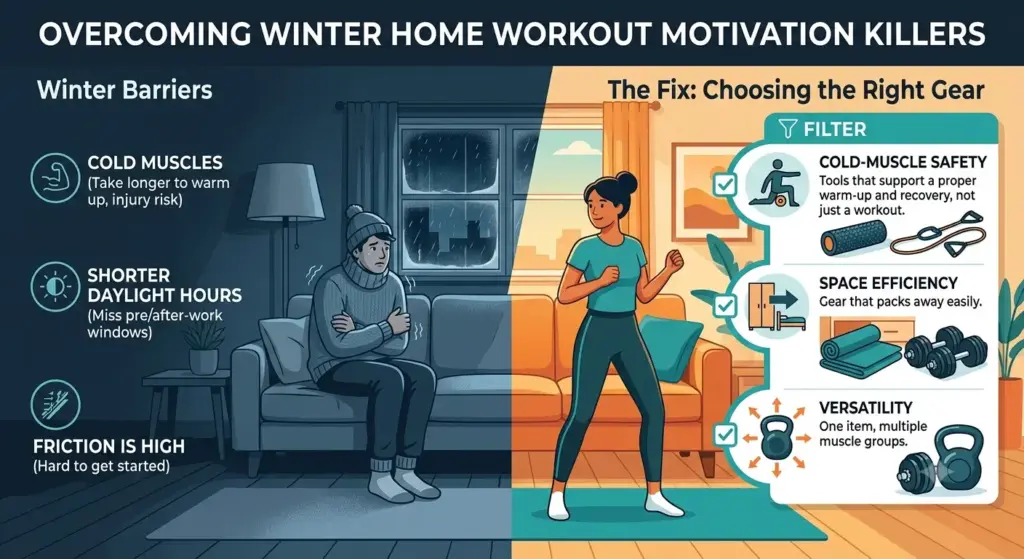
The fix isn’t a bulky treadmill taking over the living room, and it isn’t forcing yourself outside in the dark just to “prove” you trained. It’s choosing equipment against three filters, so the friction of getting started disappears even on the coldest morning:
You don’t need a big spend to stay consistent through winter, just the right gear, added in order.
Tier 1: Starter Kit (under $70) Focused on mobility and unlocking stiffness from sitting near heaters all day.
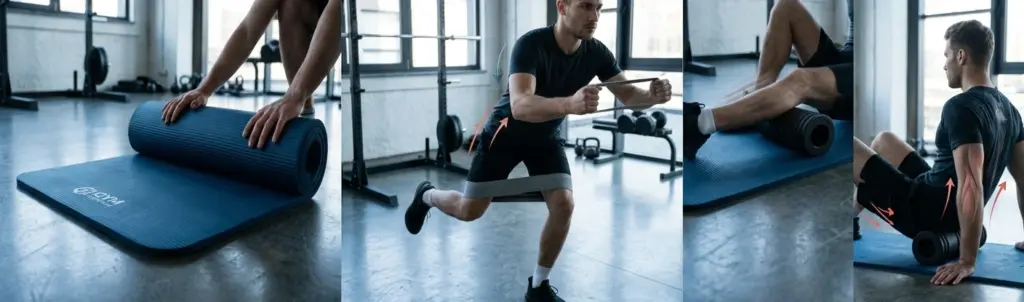
Exercise mat — protects joints from cold floors.
Fabric resistance bands — wakes up cold glutes and shoulders before lifting.
Foam roller — rolls out tight calves and lower back, increasing blood flow pre-workout.
Tier 2: Strength Builder ($70–$250)
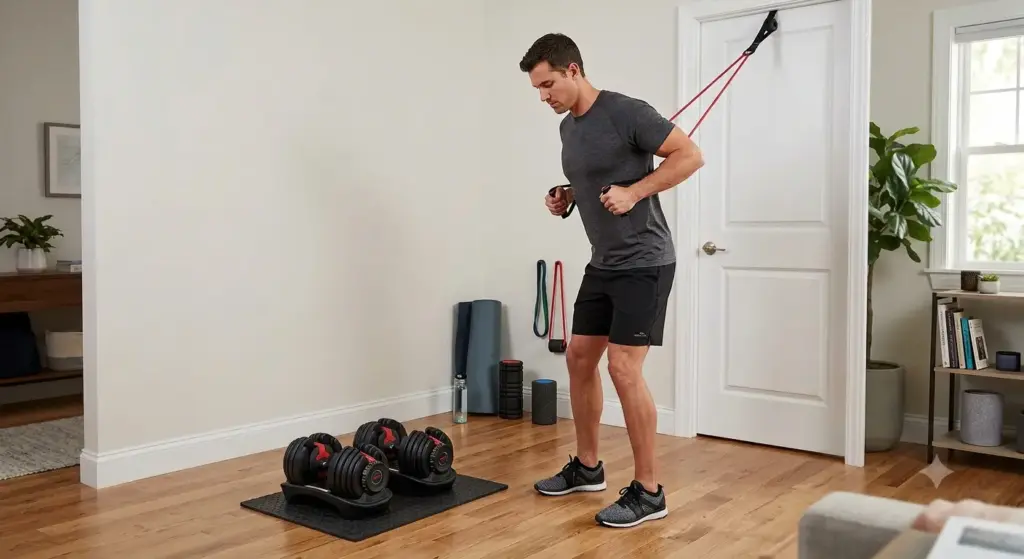
Adjustable dumbbells, one set replaces an entire rack, making them the best home workout equipment for small spaces.
Door-anchor resistance bands enable pulling movements (rows, presses) without drilling into the wall.
Tier 3: Recovery & Cardio ($250+)
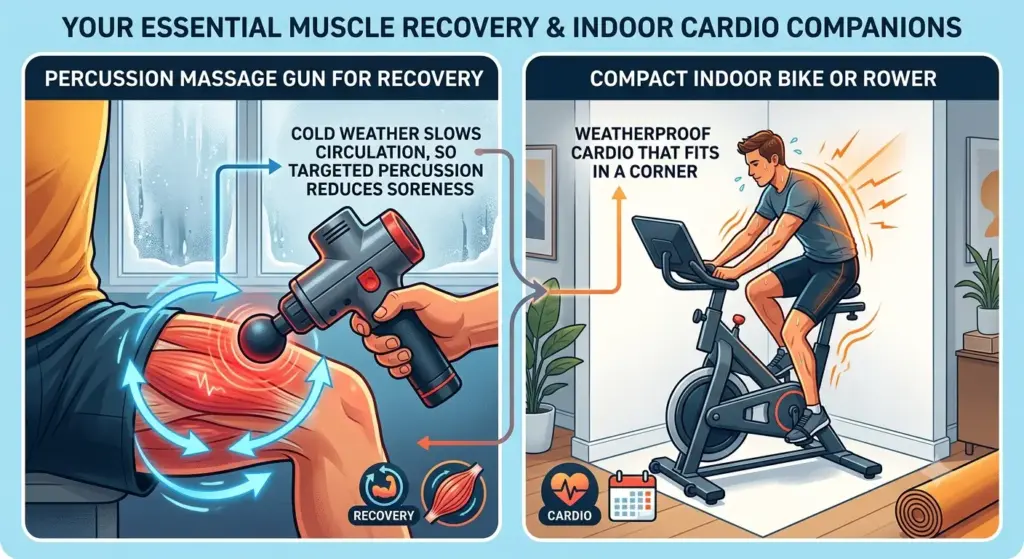
A percussion massage gun for muscle recovery: cold weather slows circulation, so targeted percussion helps reduce soreness.
A compact indoor bike or rower, weatherproof cardio that fits in a corner.
| Equipment | Best For | Space Needed | Winter Benefit |
|---|---|---|---|
| Resistance bands | Activation & toning | Zero footprint | Safely wakes cold joints |
| Adjustable dumbbells | Progressive strength | Small corner | Replaces a full weight rack |
| Foam roller | Myofascial release | Under the bed/closet | Eases stiffness from cold, inactivity |
| Massage gun | Fast muscle recovery | Drawer/box | Boosts circulation in cold muscles |
A full Tier 1–3 winter home gym setup costs roughly $265–$740 as a one-off purchase. By comparison, Australians paid an average of $77 a month for a gym membership in early 2026 — about $924 a year, according to Canstar’s national survey of over 1,300 gym-goers. That means a home setup can pay for itself in as little as four to ten months, with no further cost after that and no commute through the cold to reach it.
| One-off home gym (Tier 1–3) | Average gym membership | |
|---|---|---|
| Cost | $265–$740 total | $77/month → $924/year |
| Break-even point | N/A | 4–10 months vs. home gym |
| Weather dependency | None | Requires travel each session |
Gym memberships still make sense if social accountability is what actually gets you training; a home gym that sits unused costs more than a membership you use consistently.
Local stock can run low or get pricier once winter demand hits, especially on adjustable dumbbells and massage guns, as more people move their training indoors. If you’re building out your setup, it’s worth comparing a wider range of home gym equipment online before you commit to one option:
Adjustable dumbbells paired with resistance bands. Together they take up less than a square metre of storage and still cover a full range of strength exercises.
For beginners and intermediate training, yes, bands provide continuous tension through the full range of motion. For heavy progressive overload, dumbbells eventually become necessary.
Yes, particularly in winter. Cold weather slows circulation, and percussive therapy helps drive blood flow into stiff muscles faster than passive rest alone.
A mat, a set of resistance bands, and a foam roller. This Tier 1 combination builds safe movement habits before adding weighted equipment.
Adjustable dumbbells, because a single set covers a full range of weights and exercises, replacing an entire rack.
There’s no single best brand; it comes down to budget and adjustability range. Compare options side by side in the fitness & exercise category before deciding.
A mat, resistance bands, adjustable dumbbells, and one recovery tool, either a foam roller or a massage gun. That combination covers strength, mobility and recovery in minimal space.

Ubuy content team consist of various writers specializing in different niches. They write blogs about different topics ranging from science, human relationships to the latest technology to share their thoughts, ideas and knowledge with the world.

Get every Newsletter